Alicante Old Town Walking Guide: Barrio de Santa Cruz and a Half-Day Route
Winding lanes, centuries-old churches and a half-day route from Gran Alacant
TL;DR — The Quick Answer
Alicante Old Town refers to the historic city centre of Alicante, Spain, comprising two distinct neighbourhoods: the whitewashed hillside Barrio de Santa Cruz and the lively El Barrio at the foot of Mount Benacantil (166 metres above sea level), directly beneath Santa Barbara Castle. Both areas are car-free and walkable, connecting the 14th-century Basilica of Santa Maria and the 17th-century Concatedral de San Nicolas — recognisable by its 45-metre blue-tiled dome — to the marble-paved Explanada de España promenade. The Art Nouveau Mercado Central, open since 1921, offers fresh seafood, local produce, and regional specialities. [Statistic]: A self-guided walk covers the main sights in 2–4 hours; check entry conditions of individual sights on the day. The old town is about 15 km from Gran Alacant — roughly 20 minutes by car via the N-332. Key takeaway: Start in the morning: Santa Bárbara Castle first, then downhill through Barrio de Santa Cruz to the Explanada, and the Mercado Central before it closes in the early afternoon.

By:Rafał Prońko — Host of Brisa Alacant in Gran Alacant on the Costa Blanca.
Alicante Old Town (known locally as El Barrio and Barrio de Santa Cruz) is a captivating historic quarter nestled at the foot of Mount Benacantil, directly beneath the imposing Santa Barbara Castle. Two distinct neighbourhoods make up this atmospheric enclave: the whitewashed, flower-draped lanes of Barrio de Santa Cruz climbing the hillside, and the lively El Barrio district below, packed with tapas bars, independent shops and street art. A self-guided walking tour through these ancient streets takes you past 14th-century churches, an elegant Art Nouveau market hall, one of Spain’s most photographed promenades, and dozens of hidden corners that most visitors walk right past. Walking the streets is free — all you need is a comfortable pair of shoes.
Why Visit Alicante Old Town?
• Barrio de Santa Cruz — Instagram-famous whitewashed lanes with cobalt blue flower pots
• Two historic churches — Basilica Santa María (14th c.) and Concatedral San Nicolás (17th c.)
• Explanada de España — iconic wave-pattern promenade with 6 million marble tiles
• Street art trail — murals and installations hidden in the lanes of El Barrio
• Tapas bars — around Plaza del Ayuntamiento and in El Barrio
• Free to walk — entry conditions of individual sights: check on the day
Alicante’s old quarter has undergone a remarkable transformation over the past two decades. What was once a slightly neglected backstreet neighbourhood has blossomed into one of the most charming historic centres on Spain’s Mediterranean coast, without losing its authentic local character. Unlike some over-touristed old towns, Barrio de Santa Cruz remains a genuine residential area where elderly neighbours chat on doorsteps, laundry dries between balconies, and cats doze on sun-warmed tiles. The old town sits just 15 km from our apartment in Gran Alacant, roughly 20 minutes by car via the N-332, making it a perfect half-day or full-day excursion. Combine it with a visit to Santa Barbara Castle for an unforgettable day of history, photography and gastronomy.
What Is the History Behind Alicante’s Old Quarter?
The history of Alicante’s old town stretches back over a thousand years to the Moorish settlement of Al-Laqant, which grew around the harbour beneath the hilltop fortress. After the Christian Reconquista in 1248, the medieval city expanded outwards from the castle slopes, creating the dense network of narrow streets you walk through today. The oldest surviving buildings date from the 14th century, including the Basilica of Santa María, which was constructed on the foundations of a mosque.
During the 17th century, Alicante prospered as a major Mediterranean trading port, and wealthy merchant families built the grand townhouses that line streets like Calle Mayor and Calle Labradores. The Concatedral de San Nicolás was completed in 1662, bringing Renaissance elegance to the neighbourhood. The 19th century saw the construction of the Explanada promenade and Mercado Central, transforming the waterfront into a stylish civic space.
By the mid-20th century, many residents had moved to newer districts and parts of the old town fell into disrepair. A sustained restoration programme beginning in the 1990s brought Barrio de Santa Cruz back to life, with freshly whitewashed facades, colourful ceramic tiles, and the now-famous blue flower pots that have become the neighbourhood’s signature. Today, the old town is a thriving blend of history, culture, gastronomy and nightlife.
What Is the Best Walking Route Through Alicante Old Town?
This self-guided walking route covers all the major highlights of the old town in a logical loop that minimises backtracking. The full circuit is approximately 2.5 kilometres and takes 2.5 to 4 hours depending on how long you linger at each stop. Start in the morning when the light is best for photography and the streets are still relatively quiet.
Old Town Walking Route — 7 Stops
Explanada de España (Start Point)
Begin your walk on Alicante’s most famous promenade, a 500-metre boulevard paved with over 6 million colourful marble tiles arranged in a mesmerising wave pattern. The Explanada runs parallel to the harbour, lined with palm trees, open-air cafes and artisan stalls. Take a moment to admire the pattern from above — the best perspective is from the elevated terrace near the port end. On summer evenings, this is where locals gather for their paseo (evening stroll), and live musicians often perform near the bandstand.
Concatedral de San Nicolás de Bari
Walk inland along Calle San Nicolás to reach the city’s co-cathedral, a stunning 17th-century Renaissance church built between 1616 and 1662 on the site of an earlier Gothic temple. The exterior is relatively plain, but step inside and look up: the soaring 45-metre dome, finished in blue ceramic tiles, floods the nave with soft light. The austere cloister is one of the most peaceful spots in the old town. Check entry conditions and opening times on the day. Respect the dress code — shoulders and knees should be covered.
Plaza del Ayuntamiento (Town Hall Square)
Continue along Calle Mayor to this elegant Baroque square dominated by the 18th-century Town Hall (Ayuntamiento). The building’s ornate facade features twin towers and a ground-floor colonnade where a brass plaque marks the official sea-level reference point for all of Spain. The square is surrounded by terrace cafes — grab a coffee and watch the world go by. On Saturdays, street performers and buskers often set up here. The tapas bars on the surrounding streets are some of the best in the city.
Basilica of Santa María
Head north along Calle Villavieja to find Alicante’s oldest church, built in the 14th–16th century over the main mosque of the former Moorish city. The Baroque facade from the 18th century features an impressive portal flanked by slender columns and a statue of the Virgin. Inside, the single Gothic nave is remarkably atmospheric, with 15th-century frescoes, a gilded Rococo altarpiece, and a Renaissance baptismal font. The church’s elevated position at the edge of Barrio de Santa Cruz gives you your first taste of the hillside quarter’s charm. Check opening times on the day.
Barrio de Santa Cruz
From the Basilica, climb the steep narrow lanes into the heart of Alicante’s most photogenic neighbourhood. Whitewashed houses with cobalt blue shutters and flower pots cascade down the hillside, connected by stone stairways, tiny plazas and arched passageways. Bougainvillea and jasmine spill over walls, filling the air with fragrance. The best streets to explore include Calle San Rafael, Calle del Pozo, and the steps leading up towards Ermita de Santa Cruz. Allow at least 30–45 minutes to wander — the magic of this quarter is in getting pleasantly lost. If you want to continue uphill, the lanes eventually connect to one of the walking routes up to Santa Barbara Castle.
MACA Museum & El Barrio Street Art Trail
Descend back to the lower old town and visit MACA (Museo de Arte Contemporáneo de Alicante), housed in a beautifully restored 17th-century building. The permanent collection includes works by Dalí, Miró, Picasso and Chillida — check entry conditions on the museum website. From MACA, explore the street art scattered through the lanes of El Barrio. Look for large-scale murals on Calle Castaos, Calle Labradores and around Plaza del Carmen. The artworks range from photorealistic portraits to abstract geometric designs, and new pieces appear regularly as part of the city’s ongoing urban art programme. This is also the nightlife district, so note the bar locations for your evening return.
Mercado Central (End Point)
Finish your walk at Mercado Central, Alicante’s beautiful Art Nouveau market hall dating from 1921. Two floors of stalls overflow with glistening fresh fish, enormous prawns, wheels of Manchego cheese, barrels of olives, strings of dried peppers and pyramids of seasonal fruit. The ground floor is dedicated to seafood and meat, while the upper gallery houses delicatessens, spice shops and a handful of small tapas counters where you can eat standing at the bar like a local. The market closes in the early afternoon and is normally closed on Sundays — check current hours on the city website before you go.
What Are the Key Landmarks Worth Visiting?
Basilica of Santa María
The oldest active church in Alicante dates from the 14th century and was built in the Valencian Gothic style over the site of the city’s former main mosque. Its Baroque facade was added in the 18th century and features elaborate carvings and a striking portal. The single-nave interior houses a magnificent gilded Rococo high altar, 15th-century chapels with original frescoes, and a Renaissance baptismal font. The church sits at the boundary between the lower old town and Barrio de Santa Cruz, making it a natural transition point on your walking route.
Check opening times on the day • Dress code applies
Concatedral de San Nicolás de Bari
This impressive Renaissance co-cathedral was built between 1616 and 1662 to designs by Agustín Bernardino. The understated exterior gives no hint of the soaring interior, where a 45-metre blue-tiled dome creates an extraordinary sense of space and light. The Baroque Communion Chapel is considered one of the finest examples of its type in the Valencian Community. The tranquil cloister, with its arched galleries and central garden, provides a welcome retreat from the bustling streets outside. The cathedral is named after Saint Nicholas of Bari, patron saint of Alicante, whose feast day on 6 December is celebrated with processions through the old town.
Check opening times on the day • Dress code applies
Barrio de Santa Cruz
This hillside residential quarter climbing the slopes of Mount Benacantil is the most photographed corner of Alicante. Whitewashed houses with brightly painted shutters — predominantly cobalt blue but also green, yellow and terracotta — line steep stairways and winding lanes barely wide enough for two people to pass. Ceramic flower pots overflow with geraniums, trailing ivy and bougainvillea, creating a riot of colour against the white walls. The neighbourhood was carefully restored in the 2000s and today strikes a perfect balance between tourist appeal and genuine residential life. The higher you climb, the better the views, eventually reaching the Ermita de Santa Cruz viewpoint with its panorama over the harbour and old town rooftops.
Open access 24/7 • Best light: morning or golden hour • Wear comfortable shoes
Explanada de España
Alicante’s signature promenade runs for 500 metres along the harbour between the port and Canalejas Park. The pavement is composed of 6.6 million tricolour marble tiles (red from Alicante, cream from Novelda, dark blue from the Basque Country) arranged in the famous undulating wave pattern that has become the city’s unofficial symbol. Rows of towering Washingtonia palm trees provide shade, and both sides are lined with terrace cafes, artisan stalls selling jewellery and leatherwork, and seasonal market kiosks. In the evening, the Explanada transforms into Alicante’s social hub, with families, couples and groups of friends strolling under the warm glow of ornate street lamps. This is the place to be as the sun sets over the harbour.
Open 24/7 • Best at sunset & after dark • Live music in summer
Where Are the Best Tapas Bars in the Old Town?
One of the greatest pleasures of visiting Alicante Old Town is eating your way through the neighbourhood’s tapas bars. The best spots are clustered around Plaza del Ayuntamiento, along Calle Labradores, and in the lanes of El Barrio. Prices vary; check the menu on site.
Nou Manolín
An Alicante institution since 1972, famous for its downstairs pintxos bar where glass displays overflow with freshly prepared seafood tapas, croquetas, and montaditos. The upstairs restaurant serves exceptional rice dishes and grilled fish. Locals and tourists both come here, so expect a wait at busy times.
Calle Villegas 3 • Check opening days before you go
El Portal Taberna & Wines
A modern tapas bar with a creative twist, using seasonal local ingredients to produce dishes like grilled octopus with sweet smoked paprika, tuna tataki with wakame, and slow-cooked pork cheeks. The wine list focuses on Spanish boutique producers, and the staff are happy to recommend pairings.
Calle Bilbao 2 • Check opening days before you go
Cervecería Sento
A neighbourhood favourite near the town hall with an excellent selection of craft beers and classic Spanish bar food. Their croquetas de jamón ibérico are legendary, and the patatas bravas with spicy alioli are among the best in the city. Friendly service and a lively atmosphere, especially on Friday evenings.
Near Plaza del Ayuntamiento • Check opening days before you go
Taberna Iberia
A hidden gem on Calle Lonja de Caballeros where the daily menu changes based on whatever arrived fresh at Mercado Central that morning. The chalkboard specials might include grilled sardines, clams in white wine, or seasonal vegetable fritters. Packed with locals at lunchtime, which is always a good sign.
Calle Lonja de Caballeros • Check opening days before you go
Local tip: The traditional Alicante rice dish you must try is arroz a banda — rice cooked in a rich fish stock, served with a side of alioli garlic mayonnaise. For dessert, order helado de turrón(nougat ice cream), a local speciality unique to the Alicante province.
Where Can You Find the Street Art Trail in El Barrio?
Alicante’s old town has quietly become one of the best street art destinations on Spain’s Mediterranean coast. The El Barrio district, which doubles as the nightlife quarter after dark, is home to dozens of murals, stencils and installations created by local and international artists. The city council actively encourages urban art through regular commissions and an annual street art festival that adds new works each year.
• Calle Castaos — The unofficial “gallery street” with the highest concentration of large-scale murals, including a photorealistic portrait spanning an entire building facade and an abstract geometric piece visible from the parallel streets.
• Calle Labradores — A mix of smaller stencil works, paste-ups and painted shutters that transform this commercial street into an open-air museum after the shops close.
• Plaza del Carmen — The informal heart of El Barrio, where cafe terraces sit beneath colourful wall art and local artists sometimes work in the open.
• Calle San Pascual — Look up to spot smaller installations, hanging art pieces and decorated balconies that are easy to miss if you’re not paying attention.
The street art changes regularly, so each visit reveals something new. For the most up-to-date map, check the Alicante Turismo website or ask at the tourist office on Plaza del Ayuntamiento.
What Is the Explanada Like in the Evening?
If you only have time for one evening activity in Alicante, make it a stroll along the Explanada de España after sunset. The promenade takes on an entirely different character once the sun goes down. The ornate cast-iron street lamps bathe the marble tiles in warm golden light, the palm trees rustle in the sea breeze, and hundreds of locals and visitors fill the boulevard for the nightly paseo.
What you will find
- • Open-air cafe terraces with harbour views
- • Artisan jewellery and craft stalls
- • Live music at the bandstand (summer)
- • Portrait artists and caricaturists
- • Ice cream vendors and churrerías
Best timing
- • Summer: 20:00–midnight is prime time
- • Spring/Autumn: 19:00–22:00 is ideal
- • Winter: 17:00–20:00 before it gets cool
- • Sunset views face west toward the marina
- • Friday & Saturday are the liveliest evenings
What Are the Best Photo Spots in the Old Town?
Top 6 Instagram Spots
Blue Flower Pot Stairs of Santa Cruz
The most iconic shot in the old town. Find the steep stairway on Calle San Rafael lined with cobalt blue ceramic pots overflowing with red geraniums. Best light: 09:00–11:00.
Ermita de Santa Cruz Viewpoint
The small chapel at the top of Barrio de Santa Cruz offers a sweeping panorama over the old town rooftops, the harbour and the Mediterranean. Perfect for golden hour.
Explanada Wave Pattern from Above
The marble tile waves are best photographed from the elevated terrace at the port end of the promenade, where the full pattern is visible stretching into the distance.
Basilica Santa María Facade
The ornate Baroque portal framed by the narrow street creates a dramatic composition. Shoot from across the small plaza for the best angle including the bell tower.
El Barrio Street Art Walls
The murals on Calle Castaos make for colourful backdrops. Visit early morning when the streets are empty and there is no one blocking the walls.
Concatedral Blue Dome Interior
Look straight up at the 45-metre dome from the centre of the nave. The blue tiles and circular windows create a stunning symmetrical composition.
Half a Day in Alicante Old Town from a Gran Alacant Base
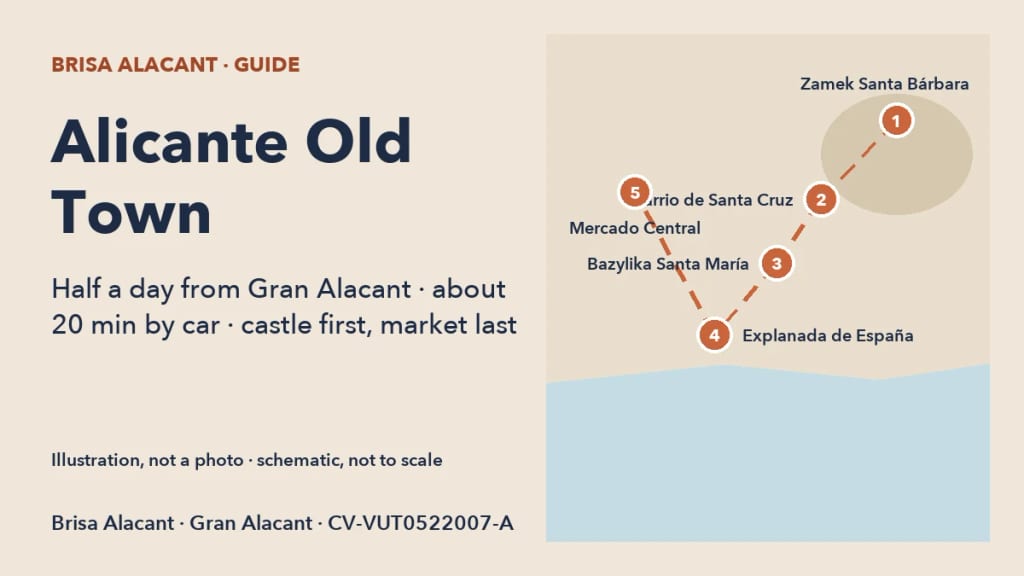
If you are staying in Gran Alacant, Alicante Old Town is an easy half-day trip: about 15 km, roughly 20 minutes by car via the N-332 when traffic is light. Start in the morning and walk in an order that saves your legs — the castle first, then downhill towards the sea — so you reach the market before it closes.
- Santa Bárbara Castle. Start at the top of Mount Benacantil for the widest view over the city, the port and the bay. A lift runs from Avenida Juan Bautista Lafora opposite Postiguet Beach; check access and opening times on the official website on the day of your visit.
- Barrio de Santa Cruz. Walk down through the narrow streets and stairways of the old quarter.
- Basilica of Santa María. A short stop at one of the oldest churches in the city and the square in front of it.
- Explanada de España. Stroll along the wave-patterned promenade by the marina.
- Mercado Central. Finish at the central market and pick up something for dinner. It closes in the early afternoon and is normally closed on Sundays — check current hours before you go.
Parking: the city centre has paid street zones and underground car parks. Read the signs before you leave the car; time limits and paid hours are shown on them.
What Practical Information Do You Need Before Visiting?
Getting There
By car from Gran Alacant: 15 km via N-332, approximately 20 minutes
Parking: Underground car parks near the Explanada and the port; check current rates on site.
By tram or bus: check current routes and timetables with the operator (TRAM d’Alacant, city buses) on the day.
From the cruise port: a short walk along the waterfront; check the port’s transfer information on the day.
When to Visit
Best months: April–May and September–October (pleasant temperatures, fewer crowds)
Best time of day: Morning 09:00–12:00 or late afternoon 17:00–20:00
Avoid: 13:00–17:00 in summer (extreme heat, siesta closures)
Summer evenings: The Explanada is magical after 20:00
Rainy days: Even rare rain adds atmospheric reflections to the tile streets
Costs
Walking the streets is free. Entry conditions of churches and museums, parking rates and restaurant prices change — check them on the day. We do not publish prices.
Tips & Essentials
Footwear: Wear comfortable walking shoes — streets are steep and cobbled
Water: Carry a bottle, especially in summer — fountains are scarce
Sun protection: Hat, sunscreen and sunglasses are essential May–September
Language: Most bar and restaurant staff speak basic English
Cash: Carry some cash for small tapas bars; most accept cards
Visiting in Autumn and Winter
Outside summer, the Old Town is calmer and walking the hills is more comfortable. We do not promise the weather — check the forecast from AEMET, Spain’s national weather service, before you go. Pack layers: the difference between midday and evening can be noticeable. Shorter days make the half-day plan above a good fit; if it rains, the Mercado Central and the city’s museums are useful indoor options (check opening times on their websites).
Important Notes
• Siesta hours: Many shops and some restaurants close between 14:00 and 17:00 — plan accordingly
• Church dress code: Cover shoulders and knees when entering churches
• Mercado Central: closes in the early afternoon and is normally closed on Sundays — check current hours on the city website
• Steep terrain: Barrio de Santa Cruz involves significant uphill walking — not ideal for wheelchair users
• Pickpockets: Keep valuables secure in crowded areas, especially on the Explanada and at the market
• Noise at night: El Barrio gets loud on weekend nights — if staying nearby, bring earplugs
How Can You Combine the Old Town with Santa Barbara Castle?
The old town and Santa Barbara Castle are natural companions for a full-day Alicante experience. The most scenic connection is walking up through Barrio de Santa Cruz — the steep lanes eventually lead to one of the walking routes to the castle summit. Here is a suggested order (no fixed clock times):
- Santa Bárbara Castle (check access and opening times).
- Down through Barrio de Santa Cruz.
- Basilica of Santa María.
- Explanada de España.
- Mercado Central before it closes.
- Evening: dinner on the Explanada or in El Barrio.
Czytasz po polsku? This article is also available in Polish: Stare Miasto Alicante — Barrio Santa Cruz i El Barrio
Commercial Disclosure
I am the owner of Brisa Alacant apartment in Gran Alacant. Recommendations on this blog are my personal opinions from visits and are not paid partnerships with the places described.
Rafał Prońko
Owner of Brisa Alacant
Owner of the Brisa Alacant apartment since 2023, I regularly visit Costa Blanca and know the region from personal experience. All the places described on this blog I have visited myself — photos and tips come from my own visits. I help guests discover the best attractions in the Alicante region.
Frequently Asked Questions About Alicante Old Town
What are the must-see sights in Alicante Old Town?
Start in Barrio de Santa Cruz, the hillside quarter below Santa Bárbara Castle, then walk down to the Basilica of Santa María and the Co-Cathedral of San Nicolás, and finish on the Explanada de España by the port. If you have time, go up to Santa Bárbara Castle for the view over the city and the bay. Check the opening times of the churches and the castle on their official websites on the day of your visit.
How much time do you need to explore Alicante Old Town?
Plan about half a day. The walking route above, with short stops and a coffee, fits into a morning or an afternoon; add time if you go up to the castle or visit the Mercado Central. Alicante is about 15 km from Gran Alacant, roughly 20 minutes by car, so a half-day visit leaves the rest of the day free.
Where are the best tapas bars in Alicante Old Town?
The tapas bars are concentrated around the streets near Plaza del Ayuntamiento and the lanes of El Barrio. Places mentioned in this guide include Nou Manolín on Calle Villegas, El Portal Taberna on Calle Bilbao, Cervecería Sento near the town hall and Taberna Iberia on Calle Lonja de Caballeros. Opening days and prices change, so check them before you go.
How do you get to Alicante Old Town from the cruise port?
The cruise terminal is on the harbour, and the Explanada de España — the southern edge of the old town — is a short walk along the waterfront promenade. Check the port's transfer information on the day of arrival. If you come from Gran Alacant by car, use one of the underground car parks near the Explanada or the port and check current rates on site.
Is Alicante Old Town safe to visit at night?
The Old Town is busy in the evenings, especially in summer, and the Explanada stays lively. Barrio de Santa Cruz is a quiet residential area after dark, while El Barrio is the nightlife district at weekends. Use normal city precautions: keep valuables close and stay on well-lit streets.
How far is Alicante Old Town from Gran Alacant?
About 15 km — roughly 20 minutes by car via the N-332 when traffic is light.
Can I see Alicante Old Town in half a day?
Yes, if you keep to one route and start in the morning: Santa Bárbara Castle first, then down through Barrio de Santa Cruz, past the Basilica of Santa María to the Explanada, finishing at the Mercado Central before it closes in the early afternoon.
Where can I park when visiting the Old Town?
The centre has paid street zones and underground car parks. Paid hours and time limits are shown on the signs, so read them before leaving your car.
Sources & References
- Alicante Turismo - Official Tourism Portal of Alicante(accessed: 2026-05-10)
- Alicante City Council - Barrio de Santa Cruz Heritage Information(accessed: 2026-05-10)
- Ayuntamiento de Alicante — Mercado Central (horario)(accessed: 2026-10-08)
- Castillo de Santa Bárbara — castle information (lift, Mount Benacantil)(accessed: 2026-10-08)
- Comunitat Valenciana Tourism - Alicante Old Town Guide(accessed: 2026-05-10)
- Spain.info - Concatedral de San Nicolas de Bari(accessed: 2026-05-10)
More to explore near Alicante Old Town
The old town is a perfect starting point for further adventures in Alicante. Walk up through Barrio de Santa Cruz to reach Santa Barbara Castle on Mount Benacantil, 166 metres above the city (check access and opening times on the day). Food lovers should not miss Mercado Central for the freshest seafood, local cheeses and artisan products. And for the Polish-language version of this guide with additional local tips, visit our Stare Miasto Alicante article.
A Quiet Base 20 Minutes from the Old Town
Brisa Alacant is our bungalow in Gran Alacant, about 15 km — roughly 20 minutes by car via the N-332 — from Alicante Old Town. A terrace by the entrance and two patios, 3 bedrooms and 2 bathrooms for up to 6 guests, a shared community pool (not heated) and Carabassi beach about 5 minutes away by car. Tell us your dates and the number of guests and we will check whether they are free.
20 min to the Old Town
by car via the N-332
Shared community pool
not heated — and a terrace by the entrance
Carabassi beach
approx. 5 min by car
Wi-Fi • Air conditioning with heating mode • Free street parking (space not guaranteed) • Kitchen • CV-VUT0522007-A